Human and Plant
The big question of the book: does the plant sense my presence, my mood? Here you learn to pose it so that the answer is worth something.
In a nutshell
What: You check whether the plant's voltage curve changes when a person is calm or agitated nearby. The trick is the design: you work "blinded", so that your own expectation does not secretly shape the result.
You need: the sensor from 11.1 (with the event mark from 11.2), three people — one measures, one is the "test person", one rolls a die and keeps the log — and a quiet corner.
What it's about
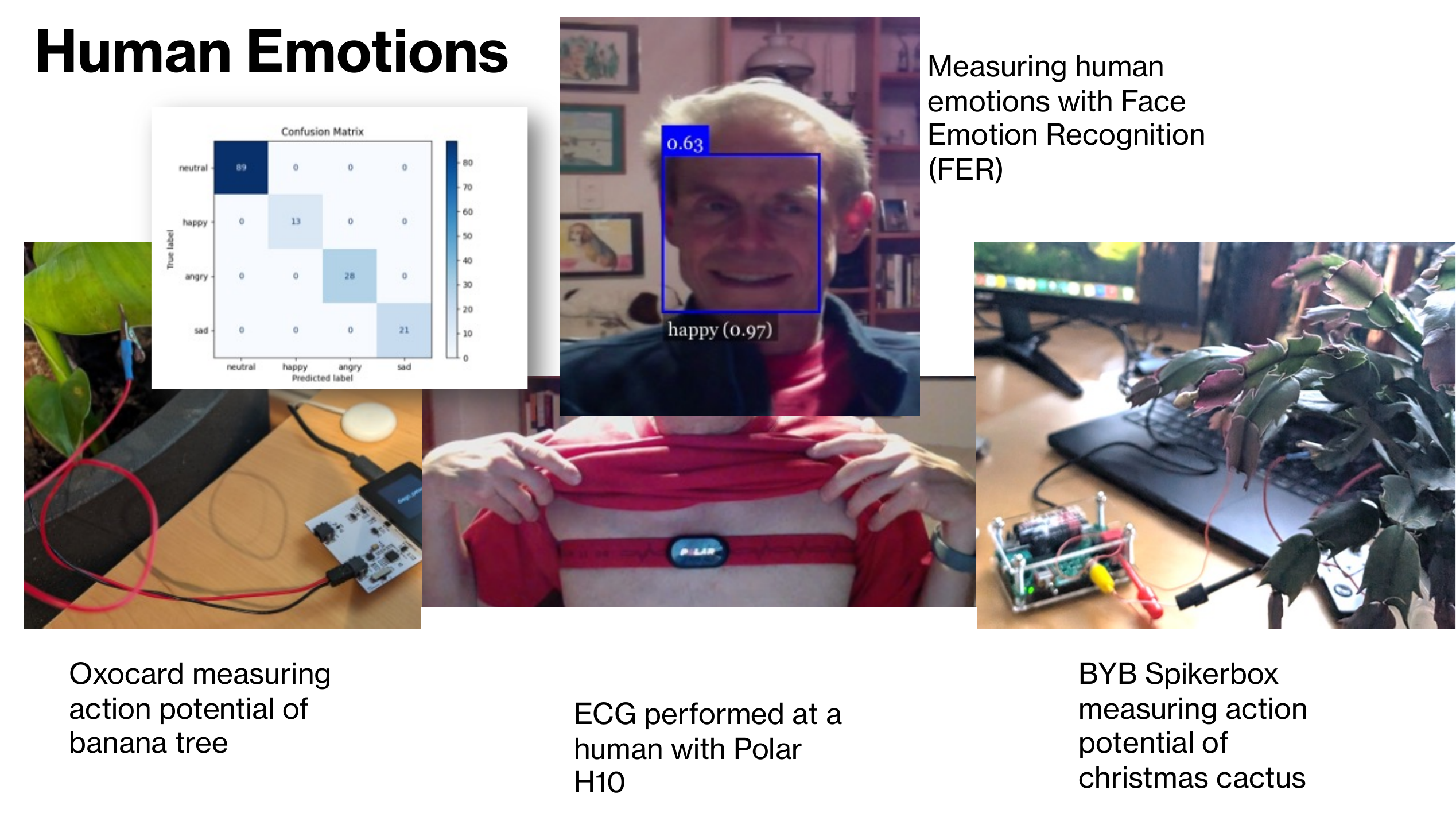
This is the activity the whole book turns on. Exactly here — at the question of whether a plant reacts to a person — is where the research this book hangs on also works: the heart–plant communication project, in which we measure whether a person's heartbeat is reflected in a plant's voltage curve. The results are cautious and contested — and precisely for that reason the method matters here more than the result.
For this is also the activity with the greatest danger of fooling yourself. If you hope the plant reacts, you will see a confirmation in every flicker. This effect — the researcher finds what she expects — must be actively switched off. The tool for it is called blinding.
The honest advance warning
It is quite possible you find no clear effect. That is not a failure — it is a result. A clean "we couldn't demonstrate anything" is scientifically more valuable than an enthusiastic "it worked!" that lacks a control. Go in open to both possibilities.
A little background
Why three people? To blind the experiment, the person who later analyses the curve must not know what just happened. One person measures and analyses without looking at what goes on in the room. A second is the test person (calm or agitated). A third secretly rolls a die for which state comes next, and writes it down — but reveals it only at the end.
What "agitated" means. We don't manipulate feelings at the push of a button, but we can change the body's state: 30 seconds of mental arithmetic under time pressure, or brisk stair-climbing, raise pulse and tension noticeably. "Calm" means: sit comfortably, breathe slowly. The difference in the body is real and measurable — whether the plant "sees" it is the open question.
Setting up the blinded experiment
- Assign roles. A measures and sits with their back to the action, looking only at the laptop/curve. B is the test person. C rolls the die and keeps the log.
- Fix the conditions. Two states: "calm" and "agitated", 2 minutes each. Plus an empty condition: "no one nearby" (B leaves the room) — the most important control.
- Roll the order. For each run C secretly rolls which of the three states comes, and notes it. Plan 9 runs (each state three times), randomly mixed.
- Set the mark. At the start of each run C presses the BOOT button (timestamp) but does not say aloud which state is running. A keeps measuring blind.
- Reveal only at the end. After all 9 runs, C discloses the log. Only now do you map the curve sections to the states.
Why the empty condition matters so much
If the curve changes even when no one is in the room, then the plant simply fluctuates on its own — and everything you attribute to B is imagination. The empty condition is your zero point. Only what goes beyond it is worth talking about at all.
Analysing
- Cut the sections. Split the recorded numbers into the 9 sections using the event marks.
- One measure per section. Compute a single number for each section — e.g. how much the curve fluctuates (standard deviation). One number per run makes the comparison fair.
- Group. Line up the three "calm" values, the three "agitated" values and the three "empty" values. Do the groups differ clearly — or do they overlap?
- Judge honestly. Only if "agitated" is clearly different from both "calm" and "empty" do you have a hint. If the groups overlap, your result is: no demonstrable effect. Both are a good result.
Worksheet
Understanding and judging the design
- Why must person A (who measures) not know which state is running? What would happen without this rule?
- What is the empty condition ("no one there") for? What does it rule out?
- Enter your nine values and mark the three groups. Do they overlap?
- Suppose "agitated" shows greater fluctuation than "calm" — but the empty condition shows the same large fluctuation as "agitated". What follows from that?
- Put your result in one sentence that is both honest and precise — without the words "proves" or "feels".
Show solution
1. If A knows the state, A (unconsciously) sees stronger deflections in "agitated" sections and reads the curve accordingly — the expectation effect. Blinding switches it off: A analyses neutrally, the mapping happens only afterwards.
2. It rules out the plant simply fluctuating on its own. If the curve changes even without a person, any "reaction to B" is just the plant's normal self-noise.
3. Individual. The decisive look: do the three groups lie apart as separate clouds (a hint of an effect) or inside one another (no effect)?
4. Then the difference between "agitated" and "calm" is worthless, because the empty condition fluctuates just as strongly. The effect is not down to the person but to the plant's natural restlessness.
5. For example: "In our blinded experiment the fluctuation of the plant curve with an agitated person was not clearly greater than at rest or with no person — we could not demonstrate an effect." Or, with an effect: "… was reproducibly greater than in both controls."
When it sticks
| Problem | Likely cause & fix |
|---|---|
| All three groups fluctuate equally strongly | Either there is no effect — a valid result — or the plant is generally restless. Check the electrode contact, let it settle longer, do more runs. |
| Huge deflection exactly on entering/leaving the room | That is vibration (footsteps, door handle), not "perception". The test person should move very slowly and without vibration; place the sensor decoupled. |
| You "obviously" see an effect, although the protocol is mixed | This is exactly what the blinding protects against. Trust the log, not the feeling. Map only after the reveal. |
| Too few runs to say anything | Three per state is the minimum. For robust statements you need many repetitions and several plants — which is why labs do this, not a single measurement. |
Food for thought
- This activity is the acid test for everything you learned in Chapter 11. It shows: the more we would like a result, the stricter we must be with ourselves. The blinding is not distrust of the plant — it is distrust of your own hope.
- "No demonstrable effect" does not mean "it doesn't exist". It means: with this setup, this plant, this number of trials, we could not show it. This modesty of phrasing is a hallmark of good science.
- Whoever has honestly carried this activity through will never again say "my sensor reads minds". That is exactly the goal of the whole book: wonder becomes judgement.
Extension
- Couple the heartbeat: combine with Activity 5.1. Measure the test person's pulse at the same time and check whether there is a temporal link between heart rhythm and plant curve — the core experiment of the heart–plant project.
- Vary the distance: repeat with the test person at 30 cm, 1 m and 3 m. A real effect should decrease with distance; an artefact (vibration) often does not.
- Build a data pool: collect the results of several groups in a shared spreadsheet. One measurement comes to nothing, twenty make a pattern — that is how science arises from a class.