Heartbeat and Stress
Not how fast your heart beats, but how irregularly — heart-rate variability reveals tension long before you notice it.
In a nutshell
What: You measure your own heartbeat at rest and under stress and work out how much the gap between two beats varies — the heart-rate variability (HRV). You will see that under stress the heart becomes more regular and the HRV drops. This is one of the most honest signals the body sends.
You need: either a chest strap (e.g. Polar H10) for clean data or just a webcam for the contactless version. The analysis runs in Python straight in your browser.
What it's about
Your pulse is never a metronome. Even when it reads "70 a minute", the gap from beat to beat is sometimes a little longer, sometimes shorter. This fine flutter is not a fault — it is a sign of health. A relaxed heart is tuned by two nervous systems at once (accelerator and brake), and their interplay keeps the intervals varied. Under stress the "accelerator" takes over alone: the heart beats faster and more uniformly, and the variability shrinks.
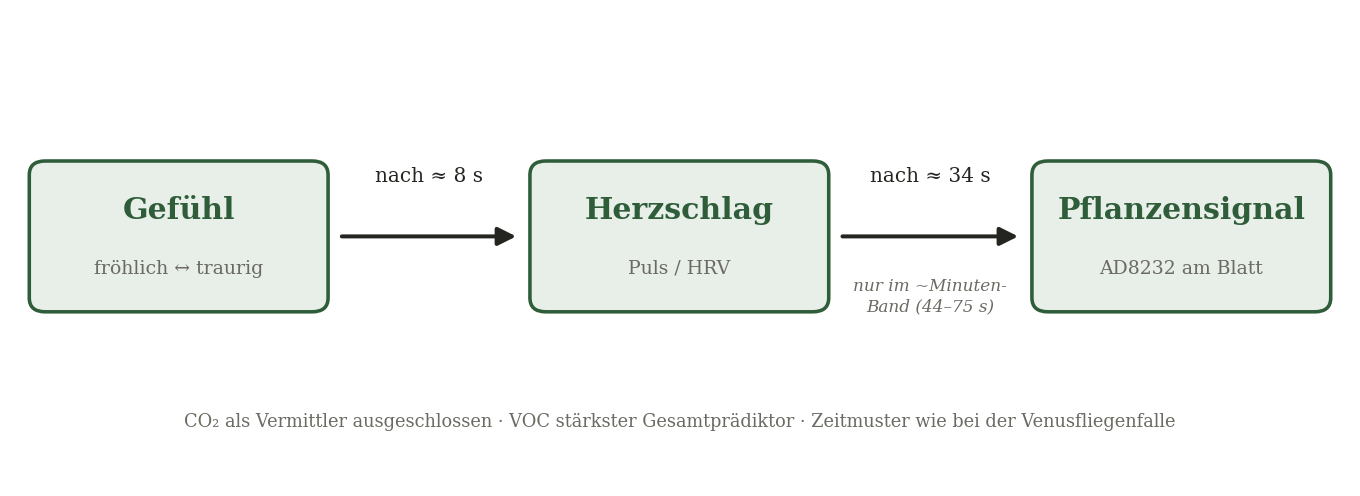
That makes HRV an honest signal in the sense of this chapter: hard to fake, coupled directly to the state of the body. These are exactly the signals the Happimeter research uses to gauge mood and stress in teams — not from what people say, but from what their bodies do.
A little background
What exactly is HRV? You measure the time between successive heartbeats — the RR intervals, in milliseconds. A common measure is RMSSD: you look at how much each pair of neighbouring intervals differs, and average that. High RMSSD = lots of variety = relaxed. Low RMSSD = uniform = tense.
Two routes to the pulse. The chest strap works like an ECG and measures the heart's electrical activity directly — precise, and the best choice for HRV. The webcam version exploits the fact that your face goes minutely redder with every beat (the blood pulses) — this is called rPPG. It is impressive, but more sensitive to movement and light. For a first look it is enough; for clean HRV the strap is better.
Measuring
- Baseline at rest. Sit comfortably, breathe calmly for two minutes, then measure for 3 minutes. Move as little as possible — movement is the main enemy of clean data.
- Create stress. Now the contrast: 2 minutes of mental arithmetic under time pressure (count backwards from 1000 in steps of 7) or some other unpleasant but harmless task. Keep measuring for 3 minutes.
- Recovery. Measure for another 3 minutes at rest and watch whether the HRV climbs back up. How fast it recovers is itself an interesting signal.
- Save the data. Export the RR intervals (strap app) or save the values estimated by the webcam. You need one list each for rest, stress and recovery.
Fairness and consent
Body measurements are personal. No one has to be measured, and no one shares their values unasked. Compare within one person (rest vs. stress), not people against each other — HRV depends heavily on age and fitness, so a ranking would be unfair and meaningless.
Analysing with Python
The code takes your RR intervals and computes the HRV (RMSSD) for each phase, showing how it falls under stress. It runs in the browser (Pyodide); the full code is on GitHub.
import numpy as np

def rmssd(rr):
    """rr = list of beat-to-beat intervals in milliseconds."""
    rr = np.asarray(rr, dtype=float)
    diff = np.diff(rr)                 # difference of neighbouring intervals
    return np.sqrt(np.mean(diff**2))   # RMSSD in ms

def heart_rate(rr):
    return 60000.0 / np.mean(rr)       # beats per minute

# ---- paste in your three measurement series (from strap app or webcam) ----
rest     = [812, 845, 798, 861, 833, 807, 850, 795]   # example values
stress   = [612, 620, 605, 618, 609, 615, 611, 607]
recovery = [740, 792, 733, 805, 758, 781, 726, 799]

for name, rr in [("Rest", rest), ("Stress", stress), ("Recovery", recovery)]:
    print(f"{name:9s}  Pulse {heart_rate(rr):4.0f}/min   HRV(RMSSD) {rmssd(rr):5.1f} ms")

# Expectation: under stress the pulse rises AND the HRV falls clearly.
What you should see
At rest a higher HRV (more variety in the intervals), under stress a clearly lower one — often halved — together with a higher pulse. During recovery the HRV climbs again, usually more slowly than it fell. If your HRV does not fall, the stress task was perhaps too easy — or the measurement too noisy.
Worksheet
Reading your honest signal
- Enter pulse and HRV for rest, stress and recovery. By what percentage did the HRV fall from rest to stress?
- Why is HRV a better stress measure than heart rate alone? (Hint: climbing stairs also raises the pulse.)
- Why do we compare a person with themselves and not several people with each other?
- RMSSD looks at the difference between neighbouring beats. Why is that more robust against slow trends (e.g. the pulse drifting up over the minute) than "just the spread of all the intervals"?
- Where is the limit: what can HRV show — and what can it not (e.g. "why" someone is stressed)?
Show solution
1. Individual; typically the HRV falls by 30–60 % under acute stress. Percent = (HRV_rest − HRV_stress) / HRV_rest × 100.
2. The pulse rises for many reasons (movement, caffeine, standing up). HRV measures more specifically the balance of "accelerator and brake" in the nervous system and responds more selectively to mental tension — even while sitting still.
3. HRV depends heavily on age, fitness and daily form. A comparison between people would be unfair and would say nothing about stress. Only comparing the same person over time is meaningful.
4. Because RMSSD compares only neighbours, a slow rise in the baseline pulse largely cancels out — each step is compared only with the one immediately before it. A measure taken over all the intervals at once would wrongly count the slow trend as "variability".
5. HRV can show that the body is in a tense state. It cannot say why (fear? excitement? joy? coffee?), and certainly not what someone is thinking. Body state ≠ thought — exactly the line drawn throughout the book.
When it sticks
| Problem | Likely cause & fix |
|---|---|
| HRV values jump around wildly | Movement artefacts or misfires in beat detection. Sit more still; drop the odd "outlier" interval (unrealistically short/long) before the calculation. |
| Webcam pulse unstable | rPPG needs even light and a still head. Sit by a window (daylight), face centred, don't speak during the measurement. |
| HRV doesn't fall under stress | Task too easy or too short. Make it harder/longer; make sure the baseline was really relaxed (not straight after running to class). |
| Chest strap gives no RR intervals | Many apps output only the pulse. Pick an app that exports RR/IBI; moisten the strap electrodes. |
Food for thought
- HRV is a textbook example of an honest signal: you can hardly fake it at will, because it is coupled to an involuntary system. That is exactly why it is so telling — and exactly why the privacy question is so delicate.
- A wearable that measures HRV continuously "knows" more about your state than you would reveal. Who should be allowed to see that data — you, your doctor, your employer? This is not a footnote but the heart of the debate about emotion technology.
- Keep the line clear: the sensor measures a body state, not thoughts and not a cause. "Tense" does not mean "lying", not "afraid of me", not "doesn't like me". Anyone who makes that translation too quickly overestimates the technology — the most common mistake in the whole field.
Extension
- Breath coupling: breathe deliberately slowly (in for 4 seconds, out for 6). Watch the HRV rise — slow breathing is the fastest way to switch on the "brake" system. A measurable self-experiment in relaxation.
- Team view (the Happimeter idea): measure (voluntarily!) several people before and after a group task. Does the group's HRV move together? This is the approach of reading a team's mood from body data.
- Bridge to Activity 11.4: take your measured heart rhythm to the plant and check whether anything in its voltage trace lines up with it in time — the core experiment of the heart–plant project, here in miniature.